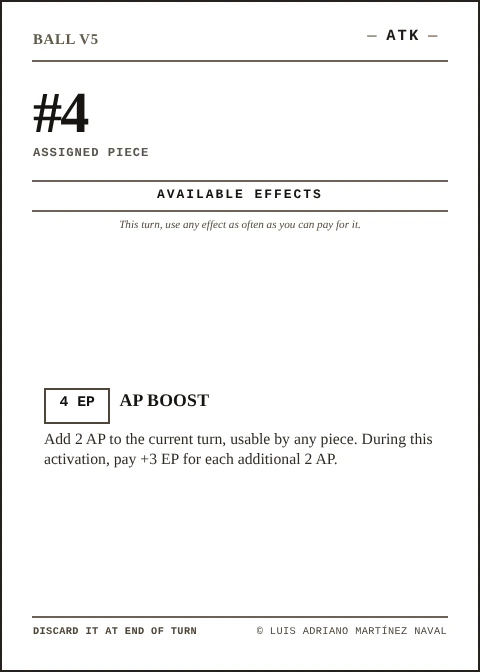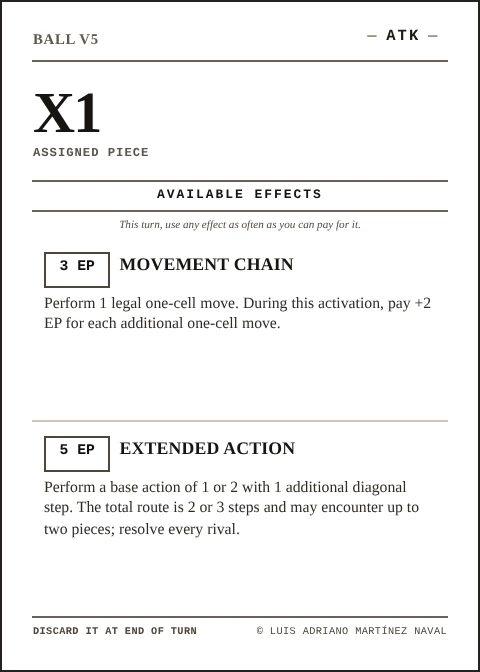
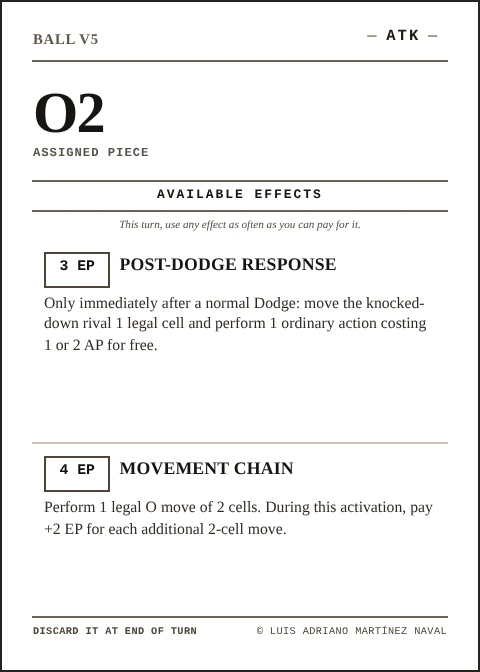
Important: the simulator teaches the deterministic core. The physical game adds the layer that makes it contemporary: Energy Points (PE), PA conversion and one-use cards.
Buy now →
NO LUCK · 0 DICE · 100% SKILL

The modern chess of tactical sport.

BALL is not “chess with a skin”. It is a contemporary system: sequence-based turns (PA), optional conversion of unused PA into PE y one-use abilities (cards), designed so the more skilful player wins - with more ways to prove it.

7
players per team
2
PA per turn (base)
1 PA = 1 PE
optional conversion
Team
multi-agent tactics
Deterministic
Repeat the position and you repeat the result. You win through reading, not luck.
More depth per turn
You do not choose “one move”. You build a sequence: PA + PE + cards.
Cinematic without dice
Blocks, dodges, fumbles and passes: spectacle generated by geometry.
Before buying: what you need to know
  • What you can try here: the deterministic core, PE generation and optional conversion of each unused PA into 1 PE.
  • What you receive when you buy: the complete game with PE, conversion and cards (the combo and drive layer).
  • Type of challenge: calculation + planning + team coordination. No luck.
  • Why it differs from chess: more states, more sequences per turn and a modern PE economy that rewards bold plays.
Built for players who enjoy:
chess / Go tactical puzzles engineering / programming strategic sport
Buy the complete game →
If you like winning on merit and hate luck, this is your game.

Simulator (try the core)

The simulator covers the deterministic core: playable squares, PA, PE, conversion of unused PA, possession, movement, blocking/protection, dodges, passes and unlocking. The complete game adds cards that let you spend PE on special effects.

DEF
ATK
Ball
Blocked / Knocked down (rotated)
Block / Protect (stacked)
Key rule
Release/unprotect occurs during the unlocking phase of the next turn of the coach controlling the top piece.
Playable squares
Only striped squares are playable (for example B1 and A2 are; A1 is not). The simulator enforces this.
Possession
The ball starts with the attacker #5. Only the ball carrier may pass.

The buying decision in 60 seconds

BALL is for you if you want a game where the best player always wins, but with mechanics deeper than “move one piece and stop”. Gain Energy Points, build spectacular combos and manage resources strategically.

1) Sequence-based turns (PA)
In chess you choose one move. In BALL you build a sequence: action → piece → destination, repeated until you exhaust PA and/or PE. This creates combos and modern tactical reading.
2) Energy (PE) = accumulated merit
Risky or technical plays generate PE (Energy Points). PE lets you execute special abilities without luck. It is a measurable momentum economy.
3) One-shot cards for each player
Each player has a unique card that can be used only once per match. This is not luck: it is resource planning. You save the trick play for the decisive moment.
4) You do not capture: you control
Blocking/protection, stacks, knockdowns and unlocking let you control space and tempo rather than remove pieces. The match stays rich to the end, with brief windows you must exploit.
Is it for you?
If you enjoy solving a small puzzle each turn and a larger puzzle across the whole match, combining actions instead of following predictable moves, and want victory to be entirely merit-based, BALL has no substitute.
Buy now → Try it first →

PE + Cards: the layer that makes BALL statistically compelling

In the complete game, energy (PE) turns your actions into planned spectacular combos. It is not luck; it is an economy. Gain PE through technical plays, weaken your opponent and spend it on one-shot cards at your best opportunity - or your most desperate moment.

Carta tipo X
Type X

Scalable mobility + action compression

  • 3 PE: 1 extra movement of 1 square. For every +2 PE: another +1.
  • 5 PE: add 1 square to an action and jump over up to 2 players; enables block/dodge combos in a single action.
#(+1) = 1 + floor((E-3)/2)
Ideal for opening lanes, punishing gaps and finishing drives.
Carta tipo O
Type O

Two-square routes + tempo swing

  • 4 PE: 1 extra movement of 2 squares. For every +2 PE: another +2.
  • 7 PE: after a dodge, move the opponent 1 square and the coach performs 1 extra action.
#(+2) = 1 + floor((E-4)/2)
Ideal for breaking coverage, pushing the defence and changing tempo.
Carta tipo cuadrado
Type □

True drive: turn multiplier (more PA)

This card does not improve one play. It improves your entire turn. It creates a burst of actions for a critical moment.

  • 4 PE: +2 PA this turn.
  • Por cada +3 PE: +2 PA adicionales.
PA_total = 2 + (2 + 2k) = 4 + 2k
With 4 PE you double the turn. With 7 PE you triple it. This is pure American-football drive.
This is NOT in the simulator.
If the simulator already feels like sports chess, the complete mode is where the full system comes alive.
Buy the complete game →

BALL versus chess: the mathematics

BALL’s strengths do not rely on impossible numbers. They are demonstrated through design: sequences per turn, additional states, PE economy y one-shot cards.

Fact
More decisions per turn
Chess: 1 decision per turn. BALL: up to 2 PA + situational 0-PA actions + PE actions in complete mode. This creates sequence-based decision trees rather than a single-move tree.
Fact
More relevant states per piece
Possession, stacking, knockdown and unlocking add layers without luck. It matters not only where you are, but which state you are in and what type you are.
Fact
More visible tactics
In BALL you do not capture: you control, push, force fumbles and block routes. Tactical complexity remains high throughout the match.

Technical comparison table

Metric Chess BALL Player consequence
Decision unit 1 move Sequence: PA + 0-PA + PE/cards More control, more combos, more reading.
States per piece position position + special rules + interactions + potential states More balanced depth without adding luck.
Interaction discrete captures blocking/protection, fumbles, pushes, chains, passes, etc. Real action generated by geometry.
Modern economy no internal currency PE, conversion and one-shot cards (planning) Saving and spending resources is part of mastery.
Multi-agent play piece-by-piece optimisation coordination of up to 7 players per turn Closer to a real sport: a team.
Balance material imbalance can persist until the position becomes oppressive for the player with few responses imbalances appear in brief windows before the opponent regains room to play Persistent advantage versus temporary advantage
Luck 0 0 The more skilful player wins. Full stop.
Why this matters
BALL does not aim merely to be more complex. It aims to be statistically stable, giving players more tools and opportunities to demonstrate skill and creativity through sequences, economy and consequential space control.

Why BALL feels like American football, even as an abstraction

It does not simulate every real rule such as downs or the clock. It abstracts what matters: drive, protection, routes, turnovers y tempo spikes.

In BALL In American football What is abstracted What it creates
End zones + touchdown territorial scoring spatial objective planning routes and coverage
Block / protection (stacking) lines / pocket screens and lanes geometric reading: close, pin, release
Dodges + fumbles tackle + turnover change of possession active defence without removing pieces
PE + PA drive / no-huddle / momentum tempo spike decisive turns and a genuine sports feel
If you like chess - and sport
Here is a game where the drive exists without rolling a single die, and where combinations, precision, strategy and tactics are never handed over to chance.
Buy →

BALL V4 gallery

Images of the board, cards, pieces and print-and-play material. The home page shows a lightweight selection; the complete gallery uses optimised thumbnails to keep loading fast.

If the video does not load because of privacy settings, your browser or external blocking, open it directly on YouTube.

Quick guide

This is a simulator interface guide. The physical game includes the complete rulebook with PE, conversion, cards and special cases.

1) Playable squares
Only striped squares are valid. Coordinates run A-M and 1-17.
2) How to perform actions
Action → player → valid destinations → target. The simulator guides you.
3) Turn and phases
2 PA per turn. In energy mode, each unused PA may be converted into 1 PE before unlocking.

FAQ: common questions before buying

Is it difficult to learn?honest answer
  • Getting started is quick: clear actions and no random tables.
  • Mastery is the point: PA sequences, PA-to-PE conversion and one-use cards raise the skill ceiling and preserve turn-by-turn complexity.
Can you win through luck?no
  • There are no dice and no luck. If you lose, you know why.
  • That makes it suitable for competitive play and tournaments.
What exactly is included?clear expectations
  • Complete PDF game with rulebook, PE, conversion and cards, plus board, recommendations and pieces.
  • The web simulator is a demo of the core so you can experience the deterministic feel.
Why not just play chess?simple
  • If you love chess, BALL does not replace it. It complements it with a modern design based on economy, sequences and team play.
  • If you like sport, BALL gives you the drive without losing chess-like purity: zero luck.
If you already like the simulator, the complete game is the logical next step.
Managing PA, PE and cards turns every match into a different tactical story without luck taking away your merit.
Buy now →